

 ES
ES PT
PT DE
DE FR
FR IT
IT NL
NL PL
PL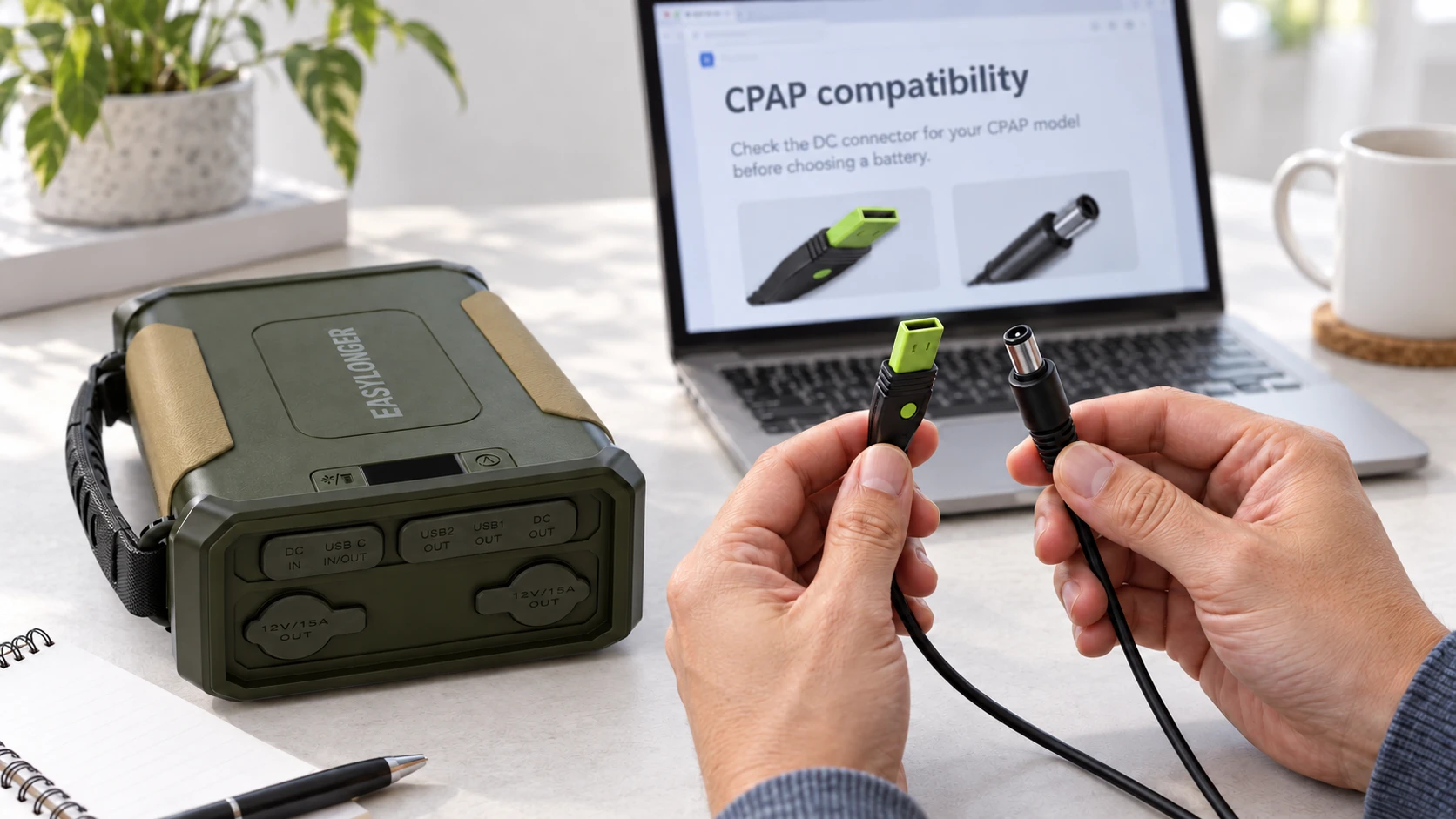
Choosing a battery for a CPAP machine starts with your exact device and its documented power connection, not the biggest capacity number on a product page. A battery can have enough stored energy and still be the wrong choice if its cable, output or operating conditions do not match your machine.
This guide explains what to check for camping and backup power, why capacity does not guarantee a certain number of nights, and how to read a documented compatibility example. Start with the machine you already own; you do not need to buy a different CPAP machine to consider a compatible battery.
Start With Your Exact CPAP Model
Write down the manufacturer and full model name from your machine’s label. Similar family names are not interchangeable: AirSense 10 and AirSense 11, for example, appear under different cable groups in the EASYLONGER ES960/GP50 manual.
Then find an explicit compatibility entry for that model in the battery documentation. A listing that says “for CPAP” or names a brand does not establish support for every machine that brand makes. If your exact model is absent, ask the manufacturer about the required cable and whether that configuration is supported before ordering.
Check Voltage, Cable and Connector Compatibility
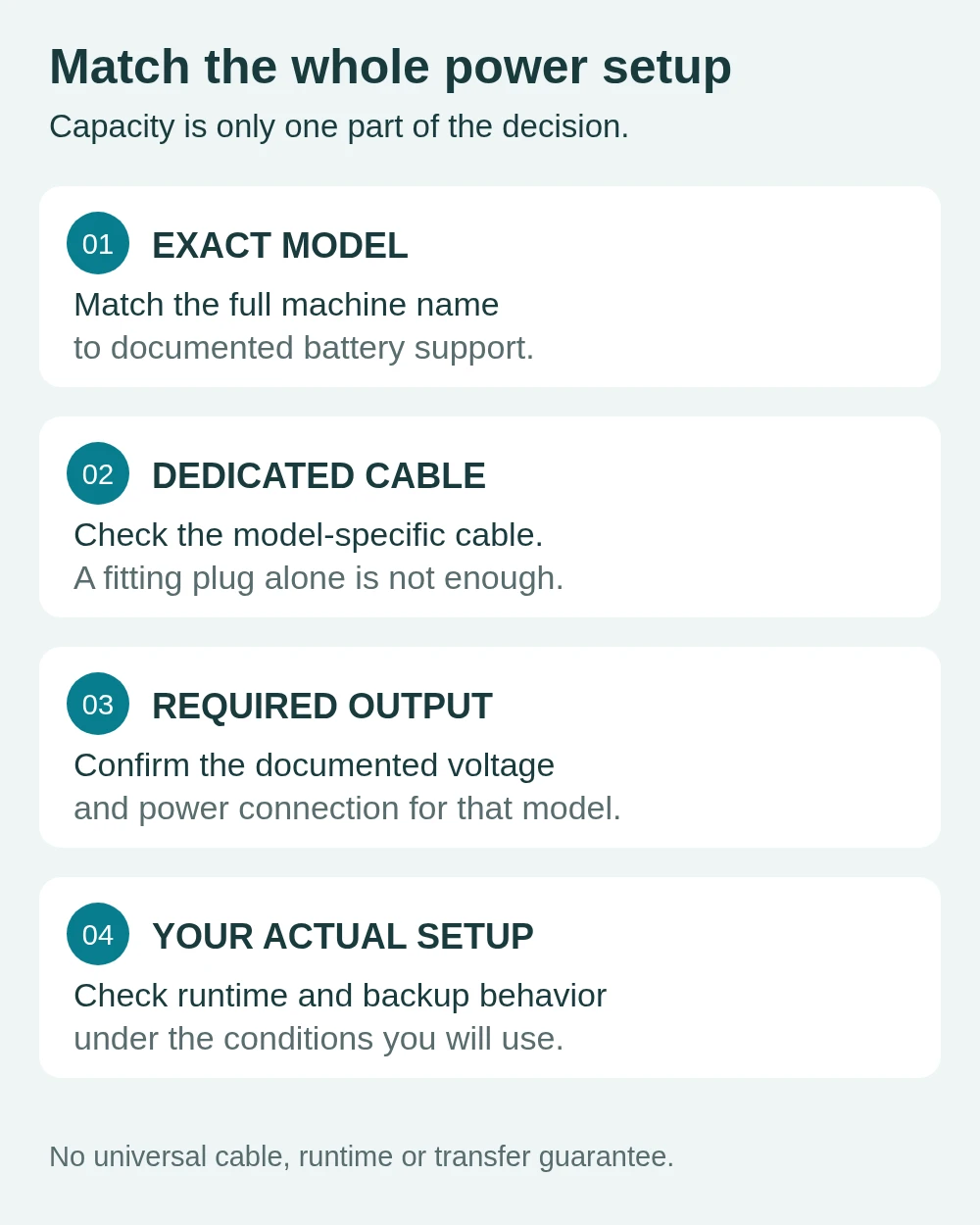
Treat the device, cable and battery output as one documented combination. A connector that physically fits is not enough, and the same voltage number does not establish compatibility with another model. Check the machine’s power requirements against both its instructions and the battery manufacturer’s model-specific guidance.
| Check | What to confirm |
|---|---|
| Full machine model | The exact model appears in reliable battery compatibility documentation. |
| Required DC cable | The model-specific cable is identified and available for your order; a generic adapter is not a substitute for documented support. |
| Output setting | The required voltage and power connection match the documented configuration. |
| How you will use it | Charging, runtime evidence and any power-transfer behavior address your intended use. |
The ES960 manual, for example, lists 24V configurations for the ResMed models in the table below and 12V for the listed Philips DreamStation models. Those values belong to those documented combinations. They are not permission to connect an unlisted machine, make a cable or choose a setting by trial and error.
Watt-Hours, Milliamp-Hours and Runtime
Watt-hours (Wh) describe stored energy. A milliamp-hour (mAh) figure needs its voltage basis to be meaningful. The ES960 manual describes the same 297.6Wh energy using two capacity bases: 96,000mAh at 3.1V and 24,000mAh at 12.4V. These are not two different amounts of stored energy.
For this example, converting mAh to Ah and multiplying by the stated nominal voltage gives 96Ah × 3.1V = 297.6Wh, or 24Ah × 12.4V = 297.6Wh. The nominal voltage used for this capacity calculation is separate from the output setting required by your CPAP. Compare energy figures on a consistent basis rather than treating the largest mAh label as the longest-lasting battery.
Stored energy still does not tell you how many nights your complete setup will run. The manufacturer’s runtime advertising includes operating conditions such as humidification and heated tubing being off. That condition cannot be assumed to match your normal setup.
When requesting a runtime estimate, provide your full machine model, prescribed operating configuration, humidifier and heated-tube use, and the hours you need each night. Ask what equipment and conditions produced the estimate. Do not change prescribed therapy settings to fit a battery claim, and do not treat a maximum marketing figure as a guaranteed overnight supply.
Camping, Backup Power and Pass-Through Charging
For camping, plan both the power you need while away and how you will recharge it. Confirm the supported charging equipment, charging time under the stated conditions, and whether you will have a suitable charging source. A theoretical recharge option is not useful if the required charger or power source will not be available.
For home backup, ask a different question: what happens when wall power fails while the battery and CPAP are connected? The ES960 manual documents simultaneous charging and discharging, also called pass-through charging. That feature alone does not establish a tested zero-interruption transfer or medical-grade UPS performance for your particular machine.
Before relying on a setup for an outage, follow the manufacturers’ instructions and have its behavior checked with your actual equipment while you are awake. If you cannot safely tolerate an interruption, discuss the backup requirements with your clinical equipment provider rather than relying on an unverified consumer-battery arrangement. This guide does not report an independent runtime or transfer test.
Air Travel Has Separate Battery Limits
The FAA’s passenger battery guidance distinguishes ordinary rechargeable lithium batteries up to 100Wh, those from 101–160Wh requiring airline approval, and batteries above 160Wh that are not permitted under those ordinary passenger limits. Spare lithium batteries and power banks must be carried in the cabin, not checked. Confirm your airline’s requirements separately.
The ES960 example here is 297.6Wh, and its manual explicitly says it must not be taken on airplanes. Do not select it as an airline-travel battery or assume a medical-device label creates an exception. Camping suitability and flight eligibility are different questions.
ES960: A Documented Compatibility Example
The following table records the seven machine models and four cable groups in the ES960/GP50 manual checked for this example. It is a document-based reference, not an independent compatibility test or a complete list of every cable EASYLONGER may now sell.
| Machine | Cable group | Documented voltage |
|---|---|---|
| ResMed S9 | S9-specific DC cable | 24V |
| ResMed AirSense 10 | AirSense 10 / AirCurve 10 | 24V |
| ResMed AirCurve 10 | AirSense 10 / AirCurve 10 | 24V |
| ResMed AirSense 11 | AirSense 11 / AirMini | 24V |
| ResMed AirMini | AirSense 11 / AirMini | 24V |
| Philips DreamStation | DreamStation / DreamStation 2 | 12V |
| Philips DreamStation 2 | DreamStation / DreamStation 2 | 12V |
The manufacturer’s current website also advertises additional model support and cables. Confirm that the cable required for your exact model is supplied with the particular order you are considering. A newer manufacturer listing does not by itself verify the contents of a seller’s existing stock. DS6 compatibility has not been established for this example and should not be inferred from a matching voltage.
Before You Buy a CPAP Battery
- Record the full model of the CPAP machine you already own.
- Find explicit model support and the correct cable in the manufacturer’s documentation.
- Confirm the cable and required charging equipment supplied with your order.
- Compare Wh capacity and runtime evidence for a setup resembling yours.
- Distinguish portable use, recharging and power-failure transfer requirements.
- Check flight rules separately if air travel is part of your plans.
Browse CPAP battery options, or review the EASYLONGER ES960 product page for the current listing and documented limitations. Use the exact-model check to decide which questions to ask; do not assume every battery in a category suits your machine.
CPAP Battery Questions
Can I use any battery with my CPAP?
No. Confirm the exact machine, supported cable and required output combination. A large capacity or a physically fitting connector does not establish compatibility.
How long will a CPAP battery last?
There is no reliable universal number of nights. Ask for evidence covering your device and operating conditions, including humidification and heated tubing. This guide does not provide measured runtime for your setup.
Can the ES960 be taken on an airplane?
No. The referenced manual prohibits taking this 297.6Wh model on airplanes. Choose a separately documented flight-eligible option and confirm airline requirements for air travel.
Does pass-through charging mean uninterrupted backup?
Not by itself. Charging while supplying a device is a capability; continuity during a power failure is a behavior that needs verification with the actual equipment.