

 DE
 ES
 FR
 IT
 NL
 PL
 PT
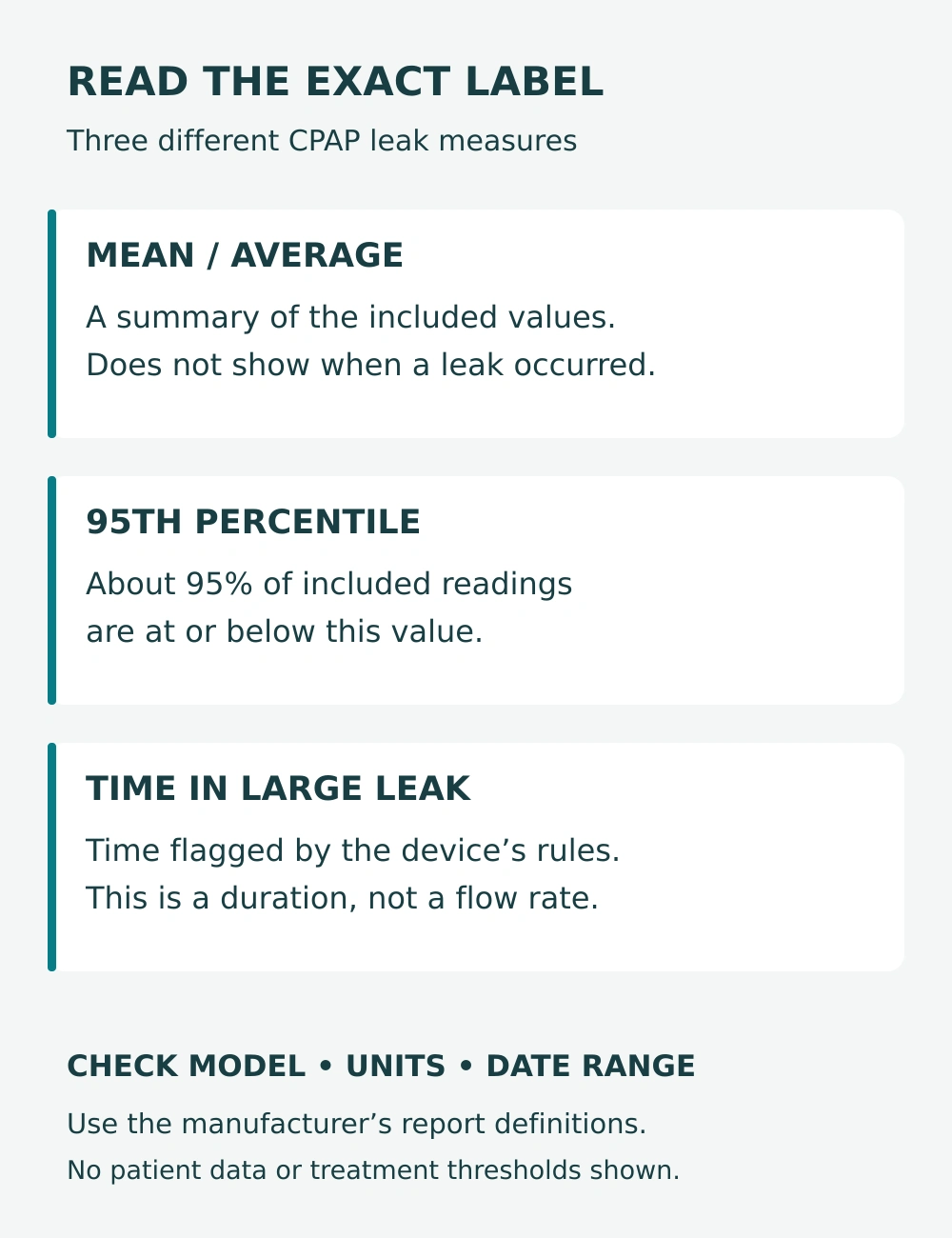
An average CPAP leak number summarizes airflow reported as leak over a selected period. It does not, by itself, tell you whether your mask fits well or your treatment is effective. First check the exact label, units and reporting period. An average, a percentile and time in large leak describe different things.
This guide helps you prepare a useful discussion with your equipment provider or sleep care team. It does not set a personal leak target or recommend pressure changes.
What does average leak on CPAP mean?
If a report identifies a value as the arithmetic mean, it combines the measured values across its reporting interval. A short period of higher leak and a longer period of lower leak can therefore produce the same average as a different pattern. The summary alone cannot tell you when the leak happened.
Check whether the report covers one session, one night or several weeks. Do not assume a field simply labeled “Leak” is an arithmetic mean. The American Thoracic Society’s tracking-systems statement explains that manufacturers use different leak definitions and that leak readings require more interpretation than usage hours. This 2013 statement establishes that limitation; its historical device table is not a current universal threshold chart.
| Report label | Question it answers | What it does not establish |
|---|---|---|
| Mean or average leak | What was the average of the values included in this calculation? | Exactly when a leak occurred or how long any one episode lasted. |
| Median leak | What value was at the middle of the included measurements? | The size of the highest readings. |
| 95th-percentile leak | What value were approximately 95% of included readings at or below? | Average leak, or a “95% good seal” score. |
| Time in large leak | How long did the device classify leak as large under its own rules? | A leak flow rate, or a diagnosis of its source. |
These are statistical distinctions, not interchangeable measures of treatment success. A percentile is a position within a set of readings. Always use the manufacturer’s explanation of which readings are included and how multiple sessions are summarized.
Why some airflow is expected
CPAP masks have intentional ventilation to help clear exhaled gas. Total leak includes that intended flow as well as unintended escape; some reports instead estimate unintentional leak. A value from one type of report cannot be compared directly with a value from the other. The ATS discussion of leak causes explains this distinction and describes possible sources including mask displacement, mouth opening during nasal-mask use, and tubing or connector problems.
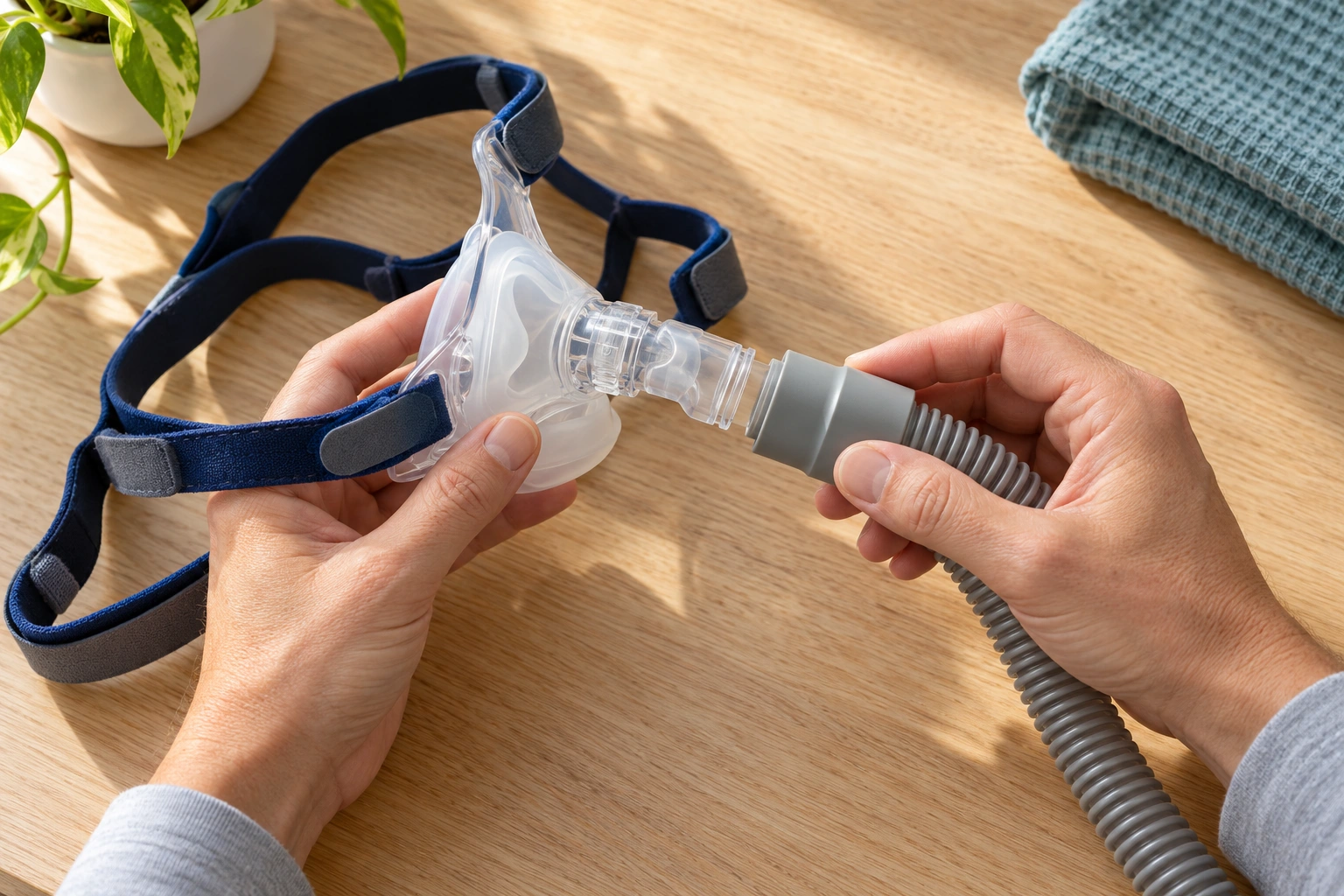
Never cover or seal the mask’s ventilation openings to improve a number. Use your actual mask and device instructions to distinguish an intended vent from an unintended escape point. The cover photograph illustrates checking a connection; it is not evidence that a particular mask or hose is faulty.
What is an acceptable CPAP leak rate?
There is no single cutoff that this article can safely apply to every device, mask and reporting method. A threshold quoted for one manufacturer’s unintentional-leak metric should not become a rule for another machine’s total-leak display. The units matter too: liters per minute and liters per second are different scales.
Ask your provider: “For this exact device and report, which leak measure should I follow, and what result should prompt a call?” Keep that answer with the report rather than relying on a number from an unrelated screenshot online.
What to check when leaks interrupt sleep
Follow the fitting instructions for your own interface. The ATS troubleshooting guide recommends checking mask adjustment, avoiding straps that are too loose or too tight, reducing tubing pull, and seeking an alternative fitting when needed.
- Check the cushion and headgear. Look for displacement and a comfortable fit; repeatedly tightening painful straps is a reason to request fitting help.
- Check hose routing. Notice whether turning over pulls the mask away. Arrange the tubing as permitted by your equipment instructions.
- Inspect connections and condition. Look for loose joints or visible damage and ask your supplier about appropriate replacement parts. Follow the cleaning and inspection steps specified for the equipment.
- Describe what you actually notice. Air at the eyes, dry mouth, noise and awakenings are useful observations. A nasal-mask leak number alone cannot prove that your mouth opened during sleep.
If interface choice is part of the discussion, our nasal mask and nasal pillow comparison explains what to compare. For maintenance, use our CPAP cleaning guide alongside the manufacturer’s instructions.
What to record before asking for help
Use the following as a conversation worksheet. Copy labels exactly, and leave unavailable fields blank instead of guessing. Save the report’s date range with a screenshot or printout so your provider can identify which night you mean.
| Record | Helpful detail |
|---|---|
| Equipment | Device model, mask model and size, and reporting app or software. |
| Report wording | Exact leak label, value, unit and selected date range. |
| Timing | Approximate awakenings or occasions when the mask shifted. |
| Experience | Noise, eye irritation, dryness, discomfort or difficulty continuing use. |
| Recent changes | New cushion, different mask, changed hose routing or damaged component. |
Ask whether the detailed trace adds anything that the summary misses, whether your equipment needs a fitting check, and when to follow up after an agreed change. For a broader handover checklist, see starting CPAP therapy.
When to contact your care team
Contact your provider when leaks persist, the mask will not stay in place, or discomfort and awakenings make it difficult to use treatment. NHLBI’s guidance on living with sleep apnea recommends discussing mask fit and leaks with your provider and describes fitting the mask while lying down with the machine running.
Bring the report and your observations even if an app gives a reassuring score. Do not change prescribed pressure or use mouth taping based on this article. Your care team can interpret the equipment data in the context of your symptoms and treatment plan.
Frequently asked questions
Does a 95th-percentile leak mean my mask sealed for 95% of the night?
No. It describes the distribution of included leak readings. It is not a percentage score for mask fit and does not identify the cause of a leak.
Can I compare my average leak with another person’s result?
Only after checking the measurement definition, units, device and reporting interval. Even then, another person’s number does not establish your treatment target.
Does dry mouth prove that a nasal mask is leaking through my mouth?
No. Record the symptom and discuss it with your provider. A symptom and a summary number are not enough to establish the source.
Should I buy a new mask because of one high reading?
Use the reading to start a fitting and equipment discussion. Review the report and what happened that night before choosing a replacement with your provider.
Sources
- ATS: CPAP adherence tracking systems (2013 statement)
- ATS: What’s causing the leak?
- ATS: PAP troubleshooting (2021)
- NHLBI: Living with sleep apnea
Educational information only. Sources were checked for this article; no independent clinical review or physical testing of a device was performed.