

 DE
 ES
 FR
 IT
 NL
 PL
 PT
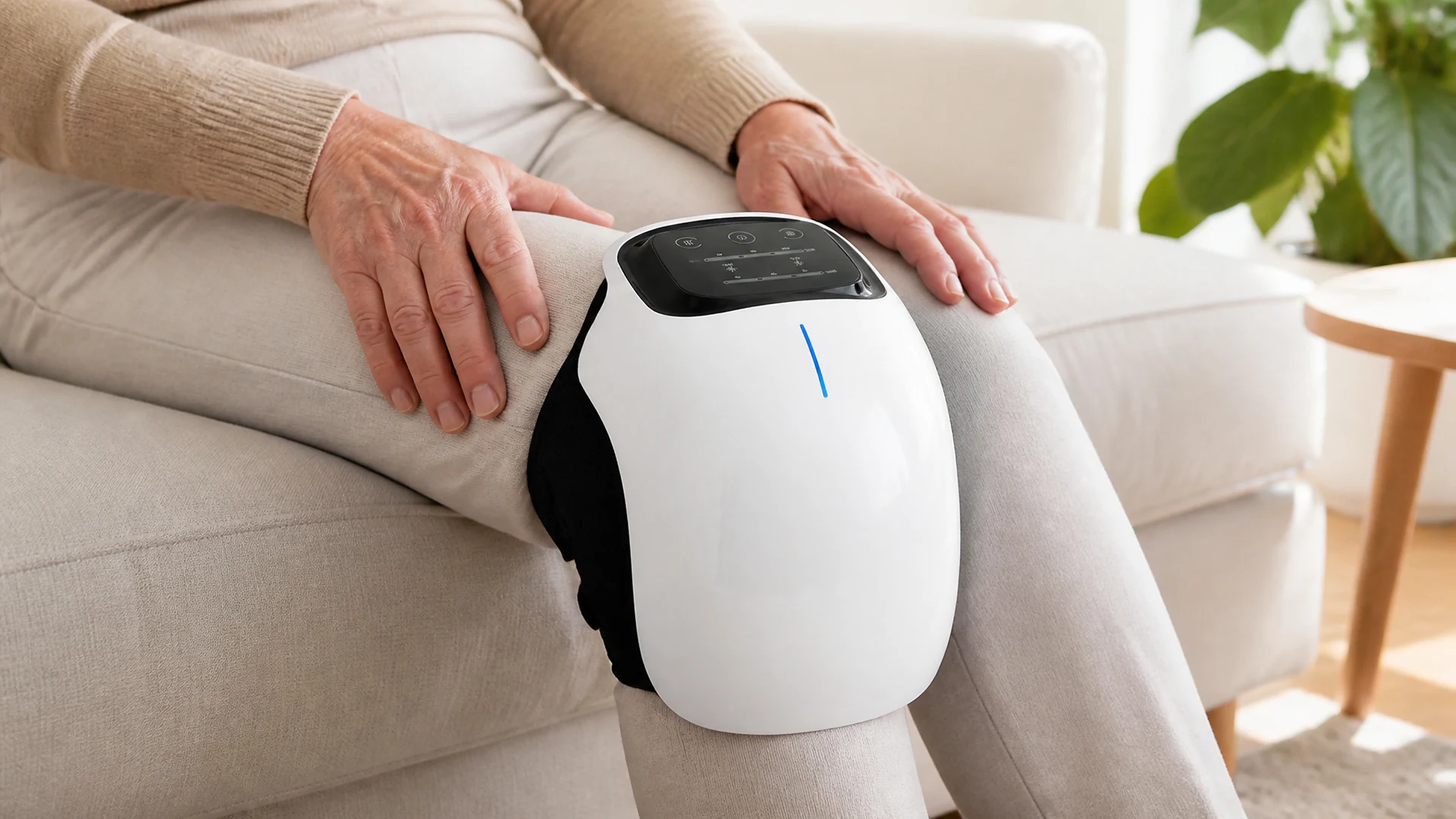
“Arthritis” covers more than one condition, and that distinction matters more than most knee massager product pages acknowledge. Osteoarthritis (the wear-and-tear kind affecting over 500 million people worldwide) and rheumatoid arthritis (an autoimmune condition) have different underlying causes, and a device that’s reasonable for one may need more caution with the other. This article looks at what the research actually supports for heat-and-vibration knee devices across both conditions.
Osteoarthritis vs. Rheumatoid Arthritis: Why the Difference Matters Here
Osteoarthritis (OA) is a degenerative joint disease driven mainly by mechanical wear, cartilage breakdown, and low-grade local inflammation. Rheumatoid arthritis (RA) is an autoimmune disease where the immune system attacks the joint lining itself, driven by systemic inflammatory markers like TNF-alpha and interleukins. Both involve inflammation, but RA is a whole-body autoimmune process while OA is more localized to the affected joint. This matters for home device use because RA patients are managing a systemic condition alongside local symptoms, which is part of why a doctor’s involvement carries more weight for RA than for straightforward OA.
What the Research Shows About Heat Therapy for Both Conditions
A 2024 comprehensive review in Fundamental Research found that heat therapy works at a molecular level for both OA and RA, not just as a comfort measure. In laboratory studies, exposing RA-affected joint tissue to 41°C for 30 minutes significantly reduced the release of inflammatory compounds and suppressed a key inflammatory signaling pathway (NF-κB) involved in both conditions. Clinically, a study of RA patients who received eight infrared sauna sessions over four weeks found significant reductions in pain, stiffness, and fatigue, with no reported adverse reactions or increased disease activity — an important finding given legitimate concerns about whether heat could flare RA symptoms.
For OA specifically, the general consensus across arthritis organizations is that heat helps relax stiff joints and achy muscles, though it doesn’t change the underlying degenerative process. It’s worth being precise about what “works” means here: the research supports symptom relief and reduced inflammatory markers, not reversal of joint damage or disease-modifying effects for either condition.
The Timing Rule That Applies to Both Conditions
Across the clinical literature, one guideline shows up consistently regardless of which type of arthritis you have: cold therapy is generally better suited to controlling inflammation during an acute flare, while heat therapy is better suited to pain management and joint function during the chronic, stable phase. If your knee is currently more swollen, warmer, or more painful than usual — a flare, in RA terms, or an acute OA episode — that’s a signal to reach for ice rather than the heat setting on a knee massager. Once you’re back to your baseline level of chronic stiffness and discomfort, heat becomes the more appropriate tool again.
How to Tell If You’re in a Flare or Just Dealing With Chronic Stiffness

This distinction isn’t always obvious, especially early on. A flare or acute episode typically involves a noticeable change from your baseline: new or increased swelling you can see or feel, warmth to the touch that’s greater than usual, pain that’s sharper or more intense than your typical day-to-day level, and for RA, sometimes systemic symptoms like fatigue or low-grade fever. Chronic stiffness, by contrast, tends to be a familiar, steady discomfort — often worse in the morning or after sitting still, easing somewhat with gentle movement, without the heat or visible swelling of an active flare. When in doubt, especially with RA, a quick call to your rheumatologist to describe the symptoms is more reliable than guessing based on a blog article.
Where Vibration and Light Fit In
The vibration mechanism covered in our heat vs. vibration guide — engaging the spinal gate control pathway to reduce pain signal transmission — applies the same way regardless of whether your knee pain comes from OA or RA, since it works on pain perception rather than the disease process itself. The red and infrared light research discussed in our red light therapy article was conducted primarily on OA patients specifically; it hasn’t been separately validated for RA to the same degree, so treat that evidence as more directly applicable to osteoarthritis than to rheumatoid arthritis.
Important Safety Notes (General Guidance, Not Product-Specific)
This product’s own description does not include a dedicated contraindication section for arthritis specifically, so the following reflects general medical guidance for heat and vibration devices rather than manufacturer-specific warnings. People with RA should be especially attentive to disease activity: a device is a reasonable addition during stable, low-activity periods, but a flare with new swelling, warmth, or systemic symptoms like fever warrants contacting your rheumatologist rather than relying on at-home heat. For OA, a knee that’s suddenly more swollen, unstable, or locking up is also a reason to see a doctor rather than continuing home treatment. Anyone with poor circulation, diabetes-related nerve damage, a pacemaker, or active skin conditions over the knee should check with a doctor before using heat or vibration devices regardless of arthritis type.
Where a Device Like This Fits in a Treatment Plan
For both OA and RA, the primary treatment approaches remain medication (NSAIDs, or for RA, disease-modifying antirheumatic drugs prescribed by a rheumatologist), physical therapy, and lifestyle factors like weight management and joint-appropriate exercise. A heat-and-vibration knee device is reasonably positioned as a non-pharmacological supplement to that plan — something that may reduce day-to-day discomfort and stiffness — not a substitute for the disease-specific treatment your doctor has prescribed, especially for RA where undertreating the underlying autoimmune activity can allow joint damage to progress even while symptoms feel temporarily better.
Frequently Asked Questions
Can a knee massager help with arthritis?
Heat therapy has molecular and clinical evidence supporting symptom relief for both osteoarthritis and rheumatoid arthritis, including reduced pain, stiffness, and inflammatory markers. It does not treat the underlying disease process or reverse joint damage — it’s a symptom-management tool, not a disease-modifying treatment.
Is heat safe for rheumatoid arthritis specifically?
Clinical studies on RA patients using infrared heat therapy found no increase in disease activity and reported significant symptom improvement with no adverse reactions. That said, heat during an active flare is generally discouraged in favor of rest and sometimes cold therapy — the stable, low-activity phase is when heat is most appropriate.
Will using a knee massager slow down my arthritis?
No evidence supports heat or vibration therapy slowing disease progression in either OA or RA. These therapies manage symptoms — pain, stiffness, inflammation markers — rather than altering the structural course of the disease. Disease-modifying treatment for RA specifically requires prescribed medication, not home devices.
The Bottom Line
Heat therapy has real, molecular-level evidence supporting symptom relief for both osteoarthritis and rheumatoid arthritis, with clinical studies showing no increased disease activity in RA patients. The key distinctions worth remembering: cold for acute flares, heat for the chronic stable phase, and a heat-and-vibration device as a supplement to — never a replacement for — the disease-specific treatment plan your doctor has prescribed, especially if you have RA. Full specs are on the Smart Knee Massager with Heat & Vibration product page.