

 DE
 ES
 FR
 IT
 NL
 PL
 PT
You have probably seen two very different things described as a “neck stretcher”: a padded collar that inflates around the neck, and a treatment-table device that applies a measured pull. Both may be advertised as cervical traction. That shared label can make them sound more interchangeable than they really are.
A cervical traction device is equipment designed to apply a pulling force to the neck. The purpose is to change the load on sensitive tissues, sometimes as one part of treatment for neck or arm symptoms. Understanding that purpose is more useful than starting with a list of products: traction, neck support and long-term recovery are three different ideas.
This article explains those differences, what research can tell us, and where a wearable home device may fit after professional assessment.
What is cervical traction actually doing?
“Cervical” refers to the neck, whose seven vertebrae surround the upper spinal cord. Nerve roots leave the spine through openings between adjacent vertebrae. A problem affecting one of these nerves can produce symptoms beyond the neck, including pain, altered sensation or weakness in an arm. The American Academy of Orthopaedic Surgeons explains this pattern as cervical radiculopathy.
Traction introduces a controlled pull along the neck. In manual traction, a clinician supplies and adjusts that force with their hands; mechanical traction uses equipment. The intended effect is to reduce loading and tension in particular structures. Cleveland Clinic describes both approaches and recommends discussing home traction with a healthcare provider first.
It helps to separate a mechanical explanation from an outcome promise. A device can apply force without proving that it will resolve the cause of your symptoms. “Decompression,” for example, describes an intended mechanical effect; on a product label, it does not establish that a damaged disc has healed or a nerve problem has been cured.
Traction, support and recovery mean different things
A support helps hold a position. Traction applies a pulling force. Recovery is the larger process of managing the condition and regaining useful function. One object may provide support while also being designed to apply traction, but those functions should still be evaluated separately.
Imagine asking three different questions about the same device. Does it hold my head comfortably? Does it deliver the kind of traction my clinician has recommended? Does using it improve something meaningful in my day? A comfortable fit answers the first question. It cannot answer the other two by itself.
Likewise, a feeling of looseness immediately after a session is a different observation from improved sleep, easier movement or better function over time. Neither needs to be dismissed; they simply should not be recorded as the same result. This distinction makes it easier to discuss progress without turning every pleasant sensation into evidence of structural repair.
Does cervical traction work? Read the finding, not just the headline
There is no single research answer that applies equally to every sore neck, every technique and every home product. A study of diagnosed nerve-root symptoms is not automatically a study of stiffness after working at a laptop. A supervised mechanical treatment is not automatically a test of an inflatable collar.
A 2020 systematic review by Colombo and colleagues examined seven trials involving 589 people with cervical radicular syndrome. Adding traction to other treatment produced a statistically significant pooled reduction in pain, but the authors judged the evidence generally low quality and the average effect not clinically meaningful.
Those two findings are compatible. Statistical significance asks whether a measured difference is likely to be explained by chance under the analysis. Clinical importance asks whether the difference is large enough to matter to a patient. A treatment headline can emphasize the former while leaving out the latter.
The useful takeaway is a question rather than a guarantee: what would count as worthwhile improvement for you, and how will it be reviewed? That might be a particular daily task rather than a sensation during treatment. Research on a category also does not demonstrate the effectiveness of the specific device pictured later in this article.
Why a sore neck does not identify the right treatment
Location alone is a poor diagnosis. Neck discomfort may involve several tissues, and symptoms spreading into an arm need a different conversation from an isolated ache. Hospital for Special Surgery explains how cervical nerve irritation can produce shoulder or arm pain, numbness and weakness, and describes assessment and nonsurgical treatment options.
For a useful appointment, describe the pattern rather than choosing a diagnosis from a product page: where symptoms begin, where they travel, which activities change them, and whether sensation or strength has changed. If your symptoms mainly occur on waking, our article on waking up with a stiff neck explores that separate situation; it is not a reason to assume traction is needed.
Home traction needs individual screening. A history of cervical fusion, conditions affecting bone strength or the spinal cord, and other medical factors can change its suitability. Cleveland Clinic advises stopping to seek medical advice for new or worsening pain, tingling, headaches or vision changes. Do not use a device to investigate new weakness or symptoms following an injury.
Why cervical traction devices can look so different
Equipment names describe a category, not a standardized treatment dose. The practical distinction is how force is produced, where support contacts the body and how the person can release it. The following is a vocabulary guide for discussing a setup, not a ranking of devices.
| Approach | How force or support is provided | Question to clarify |
|---|---|---|
| Clinician-applied traction | A clinician positions the head and applies the pull by hand. | What response are we looking for during assessment? |
| Mechanical traction | Equipment applies the pull through a supported arrangement. | How are the prescribed force, position and release controlled? |
| Over-door equipment | A harness connects to a door-mounted pulley arrangement. | Is this particular harness and setup appropriate for me? |
| Air-pump wearable equipment | A worn frame or collar uses air adjustment and supporting contact surfaces. | What does inflation change, and can the recommended setup be reproduced? |
A shape, a number of airbags or a pump setting should not be treated as a direct substitute for a prescribed traction force. Ask what a control actually measures. If documentation does not establish a conversion between a setting and delivered force, a comparison based on “more levels” alone leaves the important question unanswered.
What to clarify before considering cervical traction at home
The most useful preparation is an agreed plan. Ask your clinician whether traction is appropriate, which type of equipment matches that recommendation, how it should be positioned, and what should make you stop. Ask for device-specific instructions rather than borrowing a force or session length from somebody else’s routine.
Bring the actual product page or instructions to that conversation. An equipment name may hide differences in contact points, release mechanisms and adjustment methods. “Home traction” is too broad a description to confirm that the device in your cart matches the treatment discussed in an appointment.
It is also worth agreeing on how you will report the response. A brief note can separate what happened during use, what happened afterward and which ordinary activities changed. That is more useful than increasing a setting because the stretch no longer feels as noticeable. Any change to the plan belongs in follow-up, not in a competition to tolerate a stronger pull.
Where a wearable air-pump device fits into the picture
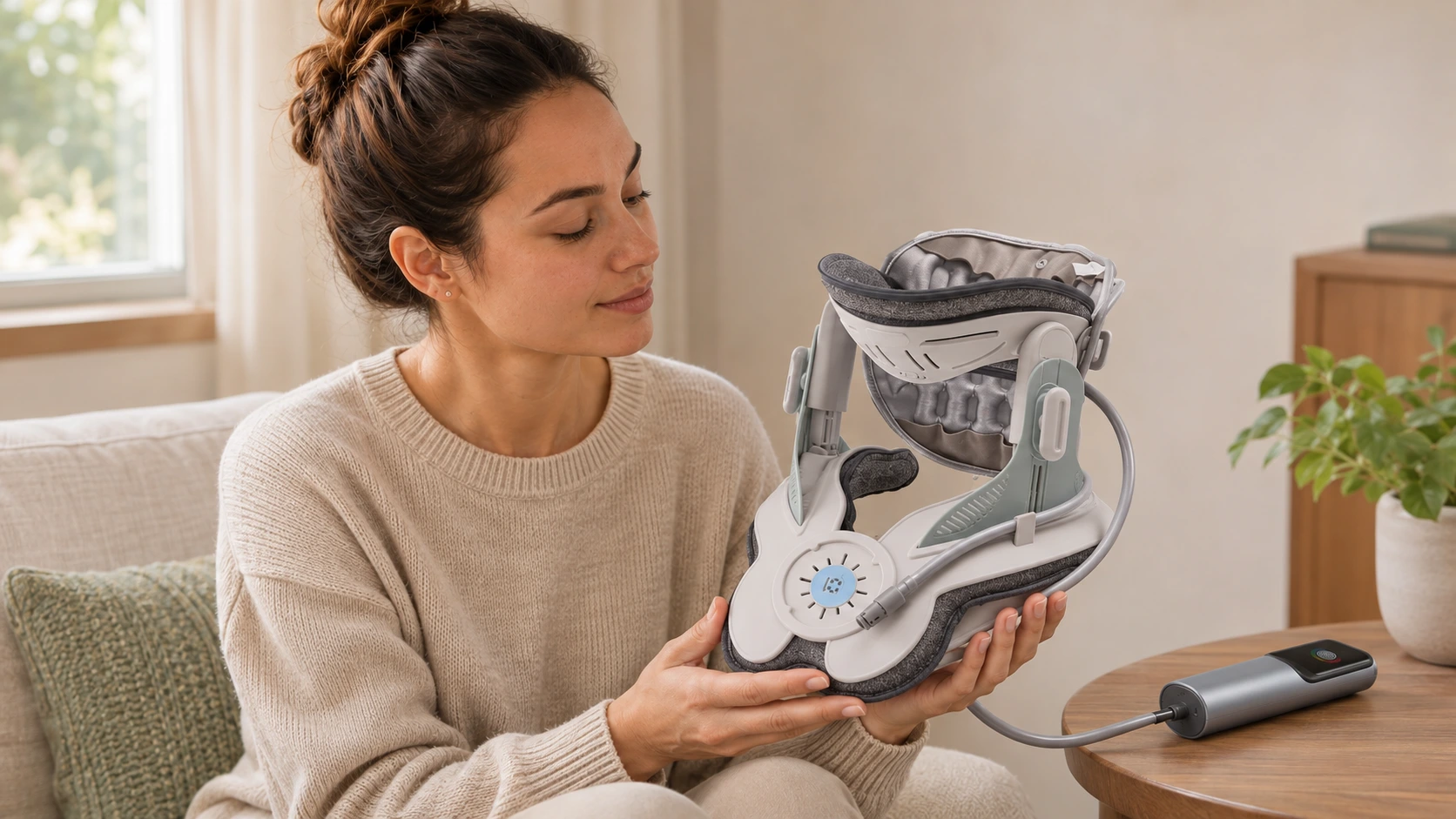
Once the distinction between support and treatment is clear, a real product is easier to understand. The air-pump cervical neck traction device available from Pophaw has a wearable frame, padded contact areas and pump adjustment. Its listing describes eight-airbag support. The photograph shows its physical format; it is not a clinical result.

If this is the format you are considering, use the product details to ask about fit, support placement and release before purchase. The listing is a reference for the item being sold, not evidence that it reproduces a particular clinical traction protocol. We have not established product-specific clinical efficacy here, and general traction research should not be presented as a trial of this device.
Questions that often come up
Is a neck brace the same as a cervical traction device?
No. A brace may support or restrict movement without delivering a controlled pull. Some wearable products combine support and traction features, so the mechanism matters more than the word “collar.” Ask what the device is designed to do and whether that matches your care plan.
Does stronger inflation mean better treatment?
No such conclusion follows from the setting alone. A higher setting does not establish a better clinical outcome, and it may not represent the same force across different devices. Follow the individual plan and the device instructions rather than using the strength of the sensation as a target.
Can cervical traction replace physical therapy?
A device is one possible tool, not a complete rehabilitation program. AAOS describes traction within physical therapy alongside exercises, while HSS discusses it among nonsurgical options. Whether it belongs in your plan depends on assessment and response; owning equipment does not replace that process.
How many minutes should a home session last?
This article does not set a universal duration. The device, diagnosis, position and prescribed plan need to be considered together. Ask for written instructions that cover duration, frequency, adjustment, release and stop signals before beginning home use.
Sources and further reading
The following resources were checked on November 6, 2026. This educational article explains terms and research limits; it does not diagnose neck pain or prescribe a traction regimen. No product testing or separate clinical review is claimed.