

 DE
 ES
 FR
 IT
 NL
 PL
 PT
Pressing on a sore spot feels productive, almost instinctive — find the knot, push into it, hope it lets go. That instinct is usually safe on the shoulders, the upper back, even most of the neck itself. It is not safe everywhere on the neck, and the areas where it matters most are not obvious from how they feel.
A structure that can trigger a sudden drop in heart rate or blood pressure does not announce itself with pain beforehand. It just responds the moment real pressure lands on it, which is why a handful of specific zones deserve attention before you or anyone else presses into them with any real force.
The Front of the Neck: Where the Carotid Sinus Lives
The carotid sinus sits where the common carotid artery splits into its two branches, roughly level with the top of the Adam’s apple, just beneath the jaw angle. It is a cluster of pressure-sensing nerve endings whose job is telling the brain how high blood pressure is right now.
Firm, sustained pressure directly on this spot can trigger a reflex that slows the heart and drops blood pressure within seconds, sometimes enough to cause lightheadedness or fainting. This is a documented physiological reflex that clinicians are trained to avoid triggering during neck examinations, not a theoretical risk invented for a disclaimer.
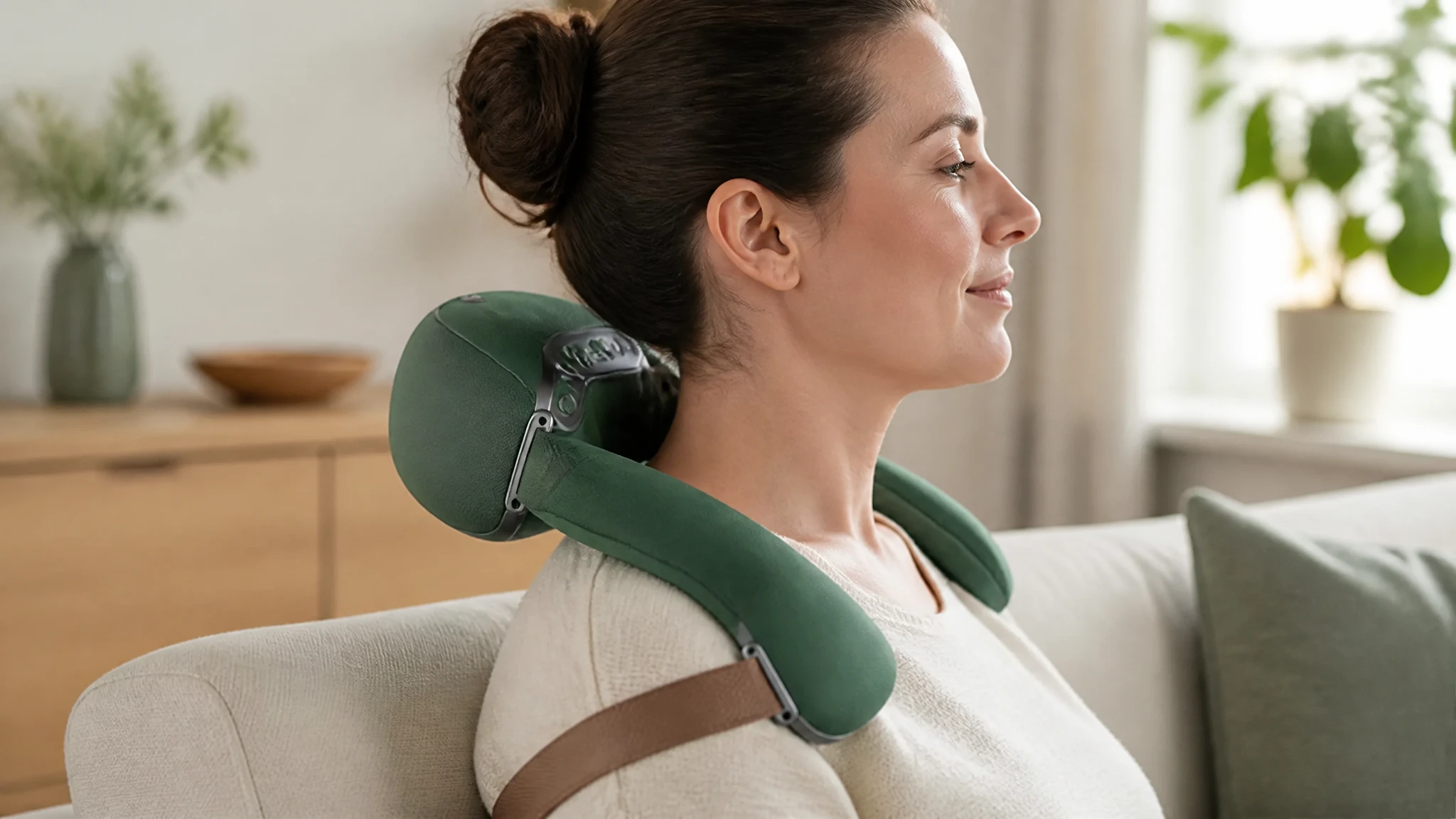
Deep thumb pressure, a massage ball, or anything that concentrates force into a small area at this spot should be avoided. This is also why a device designed for the neck, including the one covered on this site, is built to sit at the back and sides, with kneading nodes never positioned against the front of the throat.
The Upper Neck, Just Below the Skull
Where the neck meets the base of the skull, the vertebral arteries curve through small bony channels on their way to the brainstem. This region tolerates gentle, broad pressure reasonably well, the kind used in a typical scalp or suboccipital release.
What it does not tolerate well is strong, sustained, narrowly focused pressure combined with forceful head rotation. Vertebral artery dissection from manual therapy is rare, but documented enough in clinical literature that physical therapists are trained to screen for risk factors before doing end-range neck rotation combined with pressure.
The practical takeaway for home use is simple: keep pressure at this level light, avoid combining it with forceful head rotation, and never let anyone yank or crack the neck as part of “loosening it up.”
Swollen Glands, Lumps, and the Thyroid Area
The sides and front-sides of the neck host lymph nodes and the thyroid gland, both of which can become swollen or tender for reasons unrelated to muscle tension, such as an infection, a reactive lymph node, or a thyroid condition.
Massaging directly over a swollen or tender lump does not relieve it. A simple rule covers this: if you can feel a distinct lump, swelling, or tender node that was not there before, that is a signal for a doctor to look at it, not a target for massage. Ordinary muscle tightness feels like a band or a diffuse ache; a lymph node or thyroid nodule feels like a small, separate, specific thing under the skin.
When the Whole Idea of Neck Massage Needs a Second Look
Beyond specific anatomical zones, some whole situations deserve caution rather than a blanket yes. People on blood thinners bruise more easily and more deeply than they expect, so firm pressure anywhere can cause disproportionate bruising.
People with osteoporosis or any condition that weakens bone should use lighter pressure throughout, since even normal massage force can feel different against more fragile structures. Recent neck surgery, a recent whiplash injury, or an unhealed wound in the area are straightforward reasons to wait until a doctor clears massage specifically.
Pregnancy is often flagged as a blanket no for massage devices, and the more accurate picture is nuanced: general neck and shoulder massage is commonly considered reasonable, but anyone pregnant should check with their own provider first, since individual risk factors vary and a generic article cannot substitute for that conversation.
What Is Actually Safe, and Where Most Tension Really Lives

None of this is meant to make the neck sound untouchable. The upper trapezius, the muscles along the back and sides of the neck, and the area between the shoulder blades are where most everyday tension actually accumulates, and they tolerate firm, sustained pressure well.
This is also where the overwhelming majority of a typical massage session, whether by hand or by device, naturally lands. This is exactly the zone a device like the neck and shoulder massager covered on this site is designed around: a U-shaped body resting behind the neck with kneading arms reaching forward over the trapezius and shoulders, deliberately shaped to stay off the front midline of the throat.
Heat and adjustable intensity settings let pressure be dialed down over sensitive spots and built up over the muscle bulk that actually needs it, rather than applying one fixed force everywhere the device touches.
If you are dealing with an ordinary stiff neck rather than a specific risk zone, our guide to waking up with a stiff neck covers the timeline and early care. If screen time is the real driver of your tension, see our tech neck timeline guide for how long it typically takes to resolve.
Frequently Asked Questions
Where should you not massage on the neck?
Avoid firm, sustained pressure on the front midline of the neck, where the carotid sinus can trigger a sudden drop in heart rate and blood pressure. Use only light pressure at the base of the skull where the vertebral arteries pass, and avoid pressing on any swollen lymph node or lump.
Is it safe to massage the front of your neck?
Light touch on the front of the neck is generally fine, but firm or sustained pressure is not, because the carotid sinus near the jaw angle can trigger a reflex drop in heart rate and blood pressure. This is a physiological reflex clinicians are trained to avoid, not a precaution specific to any one product.
Can massaging the neck cause a stroke?
It is rare, but strong, sustained pressure at the base of the skull combined with forceful head rotation has been linked in clinical literature to vertebral artery injury, which can affect blood flow to the brain. Keeping pressure light in that area and avoiding forced rotation during massage avoids this risk.
Should you massage a swollen lymph node?
No. A swollen or tender lymph node, especially one linked to infection, should not be massaged, since pressing on it does not relieve it and can be uncomfortable. A new, distinct lump in the neck is a reason to see a doctor, not a massage target.
The Bottom Line
The neck is not a single uniform area where one rule applies everywhere. The back and sides, where most tension actually sits, tolerate firm pressure well. The front midline, the area right under the base of the skull, and any swollen gland or lump are different, not because they are fragile in some vague sense, but because specific structures there respond to pressure in specific, well-documented ways.
Knowing those three zones is really all it takes to massage a tight neck confidently, whether by hand or with a device built with that anatomy in mind, without turning ordinary self-care into an unnecessary risk.