

 DE
 ES
 FR
 IT
 NL
 PL
 PT
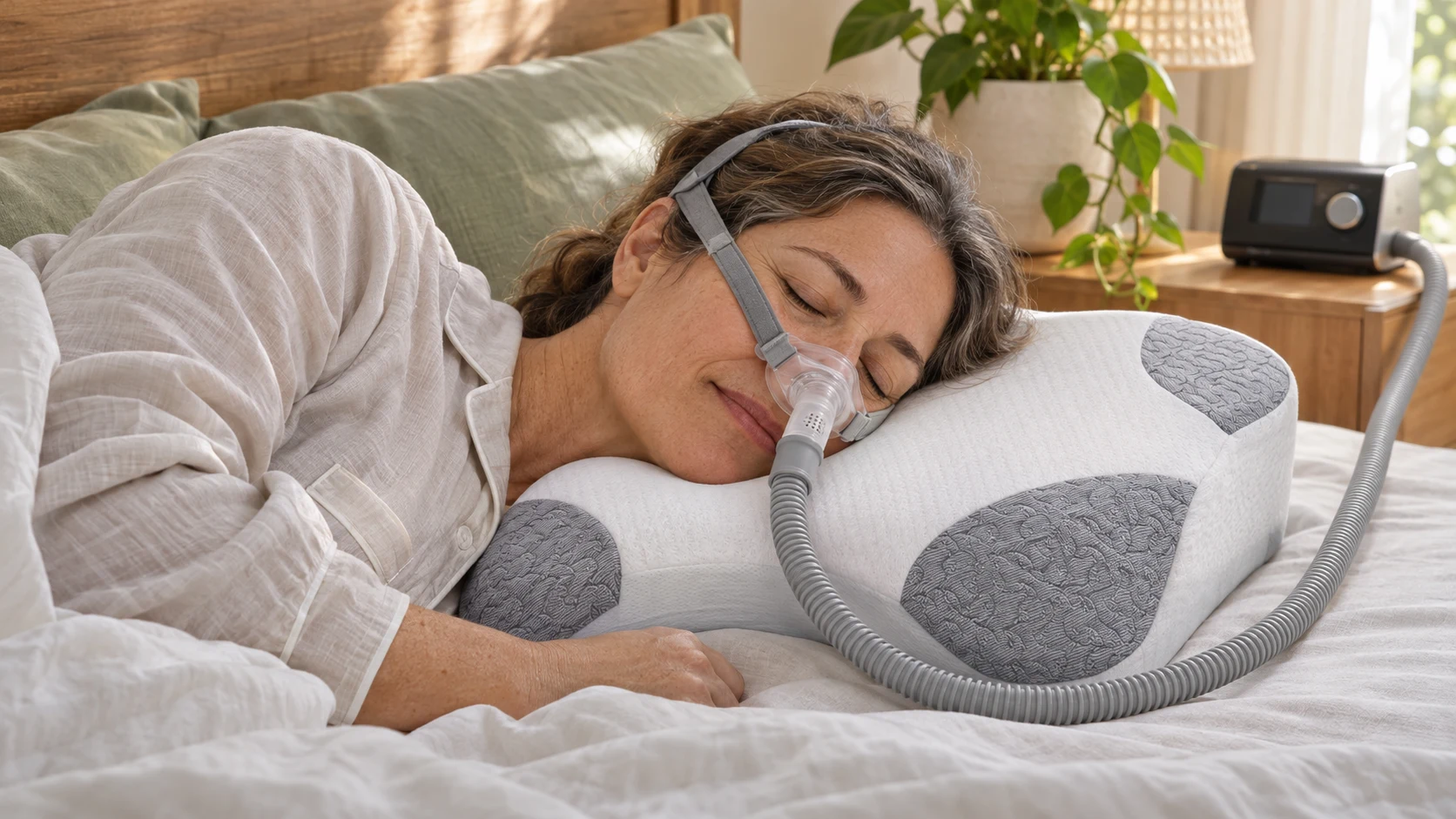
A CPAP bed pillow is the pillow underneath your head, often shaped with recesses to leave room beside a mask. It is different from a nasal pillow mask, which delivers air at the nostrils. If you searched for how to use a CPAP pillow, start with three checks: support your head comfortably, keep the pillow from pushing on the mask, and leave the hose free to move.
This guide covers choosing and positioning a bed pillow with your existing equipment. A pillow is a comfort accessory, not a replacement for prescribed CPAP therapy. For the wider equipment and learning paths, visit our CPAP resource center.
What can a CPAP bed pillow help with?
The American Thoracic Society lists a specialized sleeping pillow with cutouts or indentations among options to discuss when a PAP mask leaks at night. The same guidance includes mask adjustment and tubing management; buying a pillow is only one possible part of the setup. [1]
Think about the problem you want to solve before shopping. Is the mattress-side edge pressing on your mask? Does a thick pillow put your head at an uncomfortable angle? Does turning pull the hose? Write down the situation rather than assuming one pillow will solve every problem. If you are comparing interfaces, read our nasal mask and nasal pillow comparison.
How to choose a CPAP bed pillow
There is no single pillow shape or firmness that suits everyone. Mayo Clinic Store notes that an ordinary pillow may work if it supports you comfortably without interfering with the mask. Cutouts are worth considering when pillow contact is the specific difficulty, rather than as an automatic upgrade for every CPAP user. [2]
| Feature | What to check before buying |
|---|---|
| Height and contour | Compare the stated dimensions with your current pillow. Check whether the design has different edge heights or removable layers; do not assume it is adjustable. |
| Cutout placement | Look at where your mask sits when you lie down. A recess is useful only if it is in the right place for your face and equipment. |
| Support and firmness | Consider how far your head usually sinks into a pillow and whether the surrounding fabric reaches your mask. |
| Cover and care | Check the instructions for the cover and filling separately, including washing and drying restrictions. |
| Return conditions | Read the seller’s current conditions for opened bedding before ordering. A shape shown in a photograph cannot establish personal fit. |
For available shapes, browse CPAP bed pillows. The Pophaw CPAP pillow for side and back sleepers has contoured edges; review its current dimensions, photographs and care information. It is an accessory option for your setup, not a DS6-specific item or a guarantee of compatibility with every mask.
How to use a CPAP pillow: a practical setup check
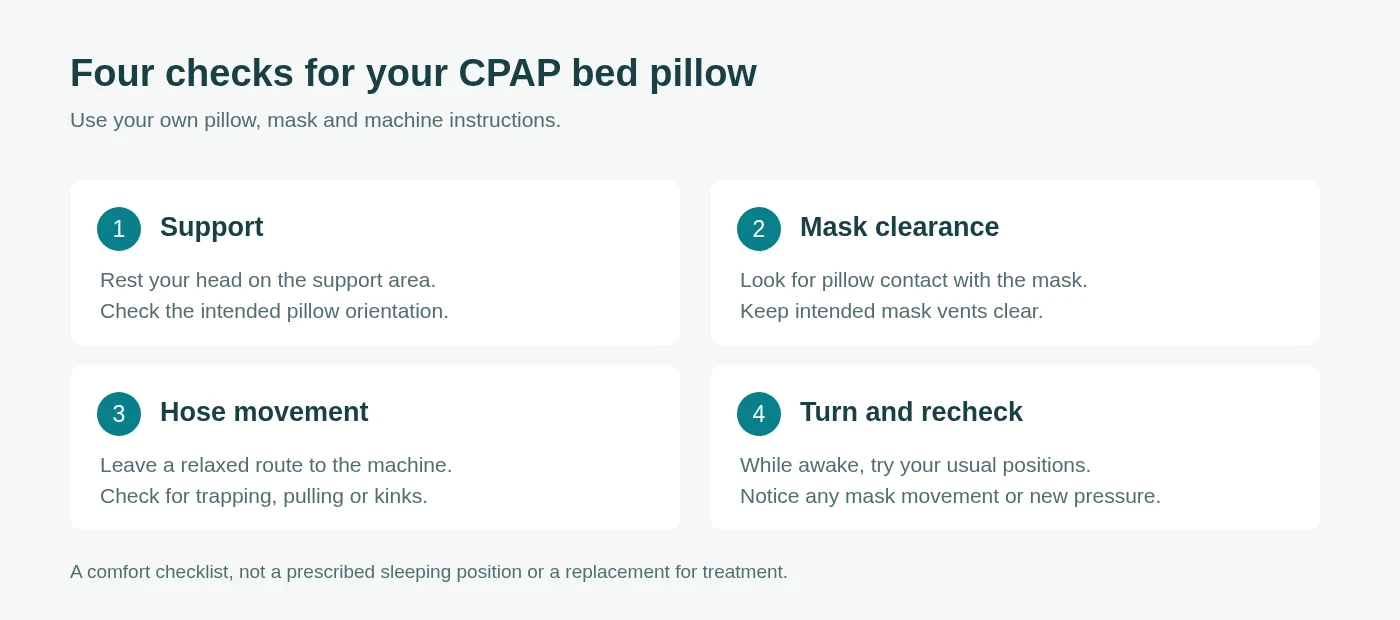
The following is an organizational checklist for checking comfort and clearance, not a prescribed sleeping position or a mask-fitting protocol. Follow the instructions supplied with your pillow, mask and machine.
- Identify the pillow’s intended orientation. Find the head-support area and any recesses in the instructions. Different designs put their high and low edges in different places.
- Settle your head and neck on the support area. Use a comfortable position consistent with your care team’s advice. Avoid balancing your head beyond an edge just to reach a cutout.
- Check the mask beside the pillow. Look for contact that shifts the cushion or presses on the frame. Keep bedding away from the mask’s intended vent openings.
- Leave a relaxed hose route. Check that the tube is not trapped underneath you or stretched tight toward the machine. Use only a holder or pillow tether as its manufacturer directs.
- Repeat the check when you turn. While awake, move between the positions you normally use and follow your equipment’s fitting instructions. Notice whether the mask or hose is being pulled.
Mayo Clinic recommends getting help with mask fit rather than repeatedly tightening straps to control leaks. A new pillow should not become a reason to accept a painful mask. [3]
What changes for side and back sleepers?
For a side sleeper, the useful question is whether the pillow edge is meeting the mask as the head settles. For a back sleeper, check whether the contour or headgear feels different once you lie down. In both cases, compare the setup in the position you actually use rather than judging it upright.
These checks do not mean that back sleeping and side sleeping are medically interchangeable. The American Academy of Sleep Medicine’s patient material notes that sleeping position can contribute to mask leakage. Discuss position-related problems with your sleep team instead of changing treatment on the basis of pillow marketing. [4]
If your mask still leaks, check the pattern
Make a brief note of what happened and take it to your equipment supplier or care team. Our CPAP leak-rate guide explains why a number needs its units, reporting period and device context.
| What you notice | Useful detail to record |
|---|---|
| Leak begins when you turn | Which side, whether the pillow touches the frame, and whether the hose becomes taut. |
| Leak persists without pillow contact | Your mask model and size, where air escapes, and any loose connections you can identify using the manual. |
| New soreness or repeated waking | When it started and what changed, including the pillow, cover, mask or headgear. |
Persistent leakage, painful pressure or difficulty using treatment deserves professional help. NHLBI advises working with your healthcare provider on mask comfort and machine settings. Do not change prescribed pressure to compensate for a pillow problem. [5]
Care for the pillow and keep useful notes
Keep the care label or instructions with your order details. A removable washable cover does not automatically mean the filling can go into a washing machine. Follow the specified cleaning and drying method, and check that a replacement pillowcase does not pull tightly across a recess.
When assessing a change, record the pillow orientation, usual position and whether contact or hose drag occurred. Change one comfort variable at a time where practical. These notes are observations, not a test proving that the pillow treats apnea. If you are new to the whole setup, our first-week CPAP preparation guide helps organize questions for follow-up.
Frequently asked questions
Do I need a special pillow to use CPAP?
No. Consider one if your existing pillow interferes with your mask or is uncomfortable. A conventional pillow that works with your setup does not need replacing just because you use CPAP.
Which way round should a CPAP pillow go?
Use the orientation specified for the exact pillow. Check which area supports your head and where its cutouts should sit; there is no universal rule that the taller edge always faces one direction.
Can I use a CPAP bed pillow with a full-face mask?
Possibly, but check the actual frame, connector and vent clearance in your sleeping position. A general product label cannot establish fit for every full-face mask.
Can a CPAP pillow replace my machine or cure sleep apnea?
No. It is a bedding accessory. Continue prescribed treatment and discuss changes with your clinician; improved comfort alone does not show that apnea is controlled.
Sources
- American Thoracic Society: PAP Therapy—Quick Tips for Troubleshooting.
- Mayo Clinic Store: Best Pillow for CPAP and Sleep Apnea—What to Look For.
- Mayo Clinic: CPAP Machines—Tips for Avoiding 10 Common Problems.
- American Academy of Sleep Medicine: Solutions to Common PAP Issues.
- National Heart, Lung, and Blood Institute: CPAP.
This article provides general education and practical questions for your equipment provider. It does not provide individualized medical advice or report a clinical test of a pillow.